Siyu Liu

AI for Materials Science Researcher

Siyu Liu

I am a Ph.D. candidate in the Materials Theory Group at HKU, building autonomous workflows that connect atomistic simulations, scientific foundation models, and large language models for accelerated discovery.

Education

Ph.D. Candidate, Mechanical Engineering
The University of Hong Kong (HKU)
2023 – 2027 (expected)
M.S., Physical Electronics
Fudan University
2020 – 2023
B.E., Materials Science and Engineering
Central South University
2016 – 2020

Experience

AI for Science InternDP Technology (深势科技)
Feb 2026 – Present
  • Designing dry–wet closed-loop solutions for the Suzhou National Laboratory.
  • Building bohrium-skills-cli to unify management of skills across the DP ecosystem.
  • Developing MatMaster, a materials-domain agent.
  • Leading Paper2Arm: high-throughput literature reproduction and agent evaluation.
LLM Algorithm InternIDEA · International Digital Economy Academy
Aug 2025 – Jan 2026
  • Built Mozi, an agent for the full drug-discovery pipeline — target discovery, hit discovery, hit-to-lead, and property optimization.
  • Focused on safety guardrails and controlled workflows so the agent system completes complex drug-discovery tasks within safe boundaries and with humans kept in the loop.
AI for Science InternShanghai AI Laboratory
Nov 2022 – Jan 2023
  • Equivariant graph neural networks for fluid-field simulation.
  • Symbolic-learning discovery of energy descriptors for lithium batteries.
Frontend Development InternAnt Group
Jun 2022 – Sep 2022
  • Improved several Alipay H5 products; implemented personalized ("thousand-faces") dynamic delivery of a frontend component via microservices, and an Alipay repayment-flow upgrade using DRM traffic switching.
  • Helped build the team's mock-data management center and maintain the department's low-code operations web platform — gaining end-to-end familiarity with the software lifecycle from requirements to release.
Frontend Development Intern4Paradigm
May 2022 – Jun 2022
  • Maintained and extended the department's algorithm-platform frontend management system: a data-source management page with Ant Design, and an algorithm-flow diagram (AntV) rendered from backend query data, with configurable steps managed through a top-level instance for data sharing and I/O validation.

Selected Research

Test-Time Self-Evolution overview figure
LLM · AI4X 2026

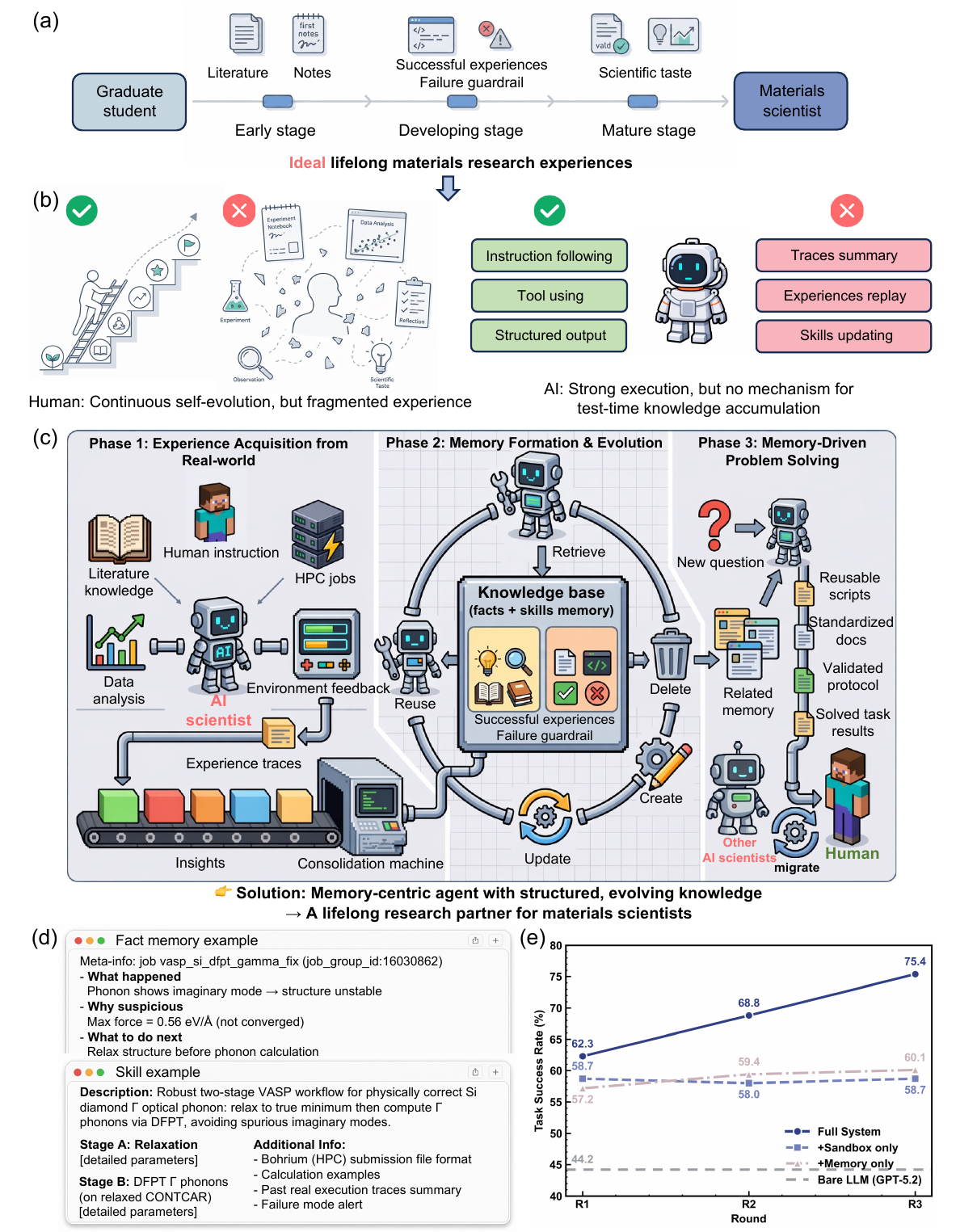
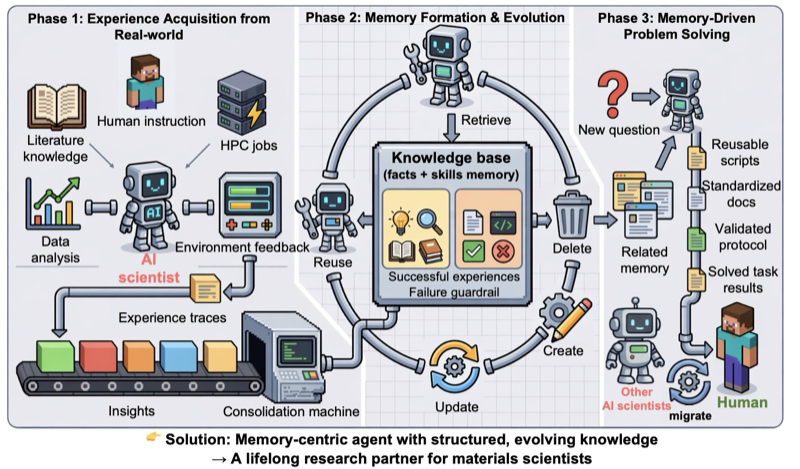
Test-Time Self-Evolution in Multi-Agent Systems for Materials Discovery

A file-system-based agent memory that distills failures into reusable Memory and successes into reusable Skills, letting LLM agents accumulate cross-task experience. Ablations on Sol27LC and MatTools confirm that removing the memory, the sandbox feedback, or cross-conversation reuse each lowers task success.

Mozi architecture figure
LLM · arXiv 2026

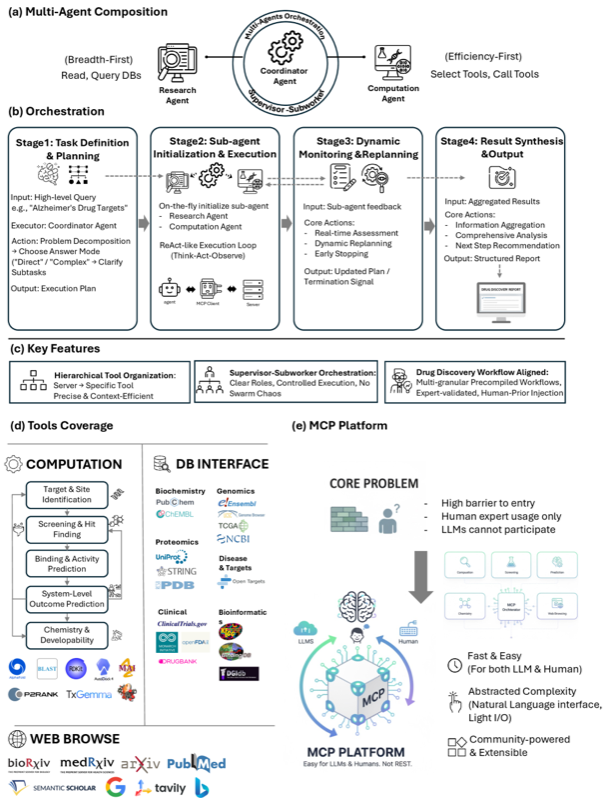
Mozi: Governed Autonomy for Drug Discovery LLM Agents

A two-plane agent architecture — a Supervisor–Worker control plane (tool constraints, role isolation, reflective replanning) over a workflow plane that models drug discovery as composable Skill Graphs with tool governance, data contracts, and human-in-the-loop. Reaches 21.4% on the HLE drug-discovery subset and beats Biomni, SciMaster, and STELLA (e.g. +65% classification accuracy over Biomni on PharmaBench, +50% MCQ, −27% regression SMAPE).

MatTools benchmark overview figure
LLM · arXiv 2025

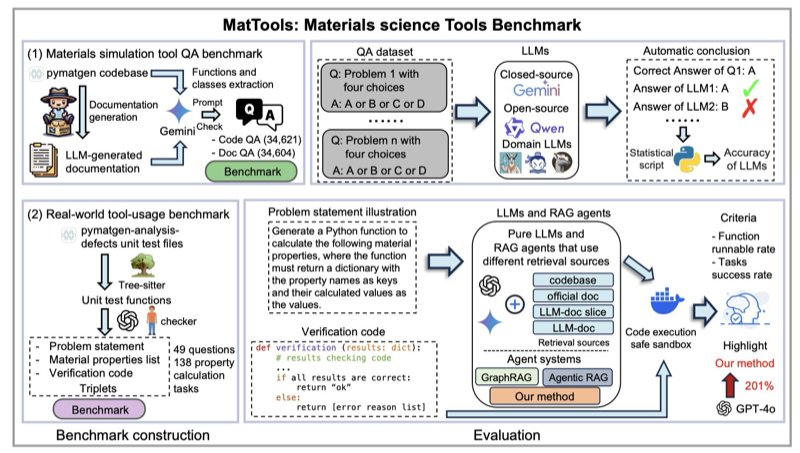
MatTools: Benchmarking Large Language Models for Materials Science Tools

Two benchmarks — materials Q&A and simulation-code generation — reveal that LLMs answer descriptive questions well but generate correct materials-computation code only ~20% of the time. Our agent system lifts that to nearly 60%.

Materials Laws Discovery framework figure
LLM · arXiv 2024

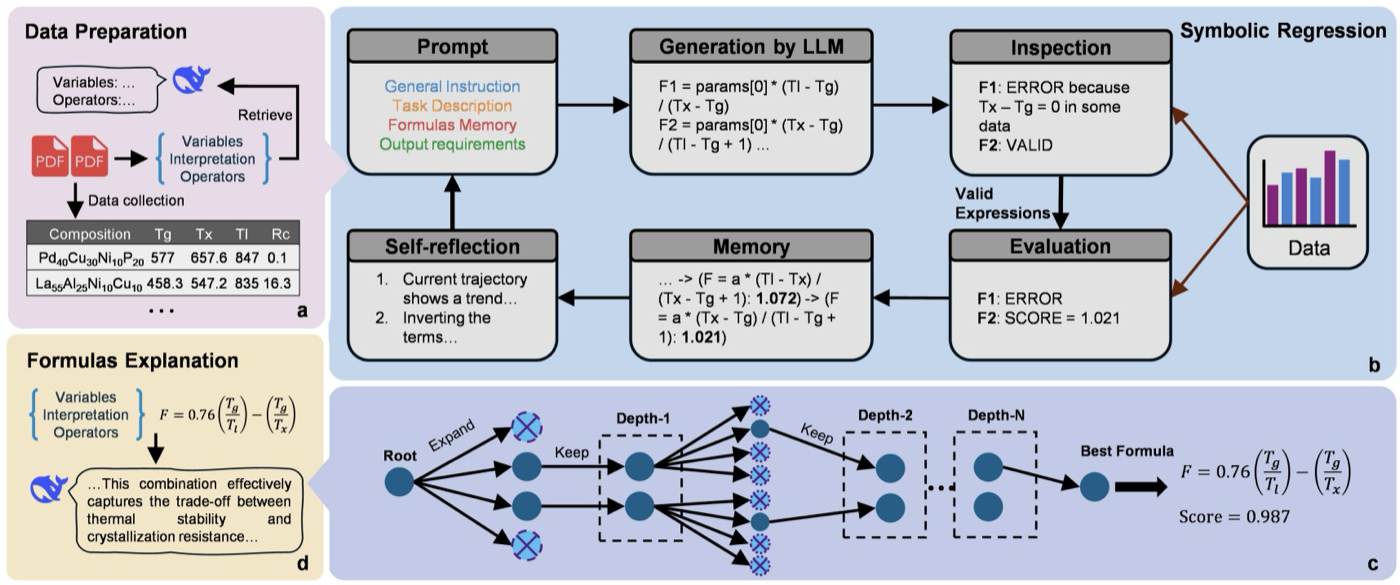
A Multi-agent Framework for Materials Laws Discovery

A multi-agent system with depth-first search over formula-derivation paths derives an interpretable law for metallic-glass forming ability (GFA), reaching R² = 0.948 at lower formula complexity than traditional approaches.

ElaTBot graphical abstract
LLM · Digital Discovery

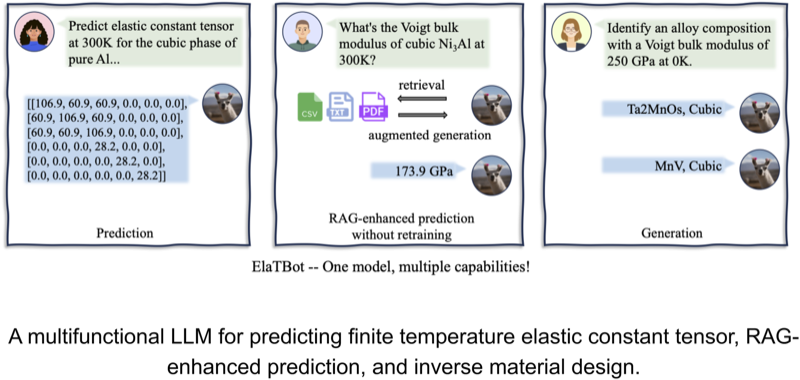
LLMs for Material Property Predictions: elastic constant tensor prediction and materials design

An end-to-end, multi-task-augmented fine-tuned LLM predicts elastic constant tensors with 33.1% lower MAE than prior materials LLMs on the same training set — while also enabling inverse (property-to-material) design and retrieval-augmented (RAG) prediction.

MgBERT workflow figure
LLM · Materials Today

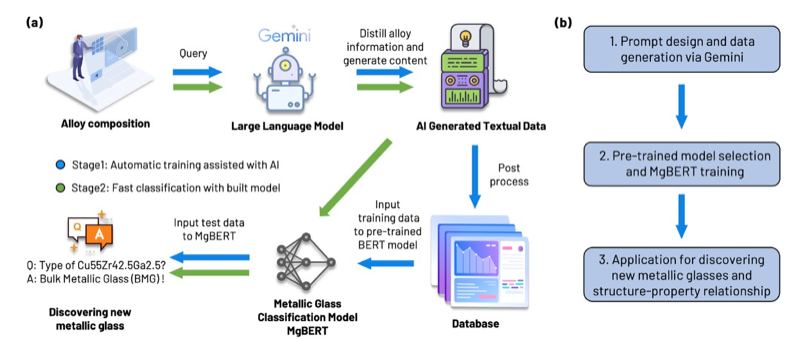
A Prompt-Engineered LLM + Deep Learning Workflow for Materials Classification

MgBERT — MatSciBERT adapted for longer token lengths and fine-tuned on Gemini-generated compositional descriptions — raises metallic-glass binary-classification accuracy from 78.2% (GBDT) to 95.2%.

Publications

Test-Time Self-Evolution in Multi-Agent Systems for Materials Discovery

S. Liu, B. Hu, B. Ye, H. Cao, D. J. Srolovitz*, T. Wen*

AI4X-AC 2026 · Oral 2026 Paper

Mozi: Governed Autonomy for Drug Discovery LLM Agents

H. Cao, S. Liu, F. Zhang, ZJ. Liu, H. Li, B. Feng, S. Bai, L. Chen, K. Xie, Y. Li

arXiv 2026 Paper

MatTools: Benchmarking Large Language Models for Materials Science Tools

S. Liu, J. Xu, B. Ye, B. Hu, D. J. Srolovitz*, T. Wen*

arXiv 2025 Paper

DrugNav: A Benchmark Dataset of Expert Trajectories for Developing and Evaluating LLM Agents in Multi-Step Drug Discovery

H. Cao, S. Liu, F. Zhang, H. Li, ZJ. Liu, B. Feng, Y. Li

NeurIPS 2025 · AI for Science Workshop 2025

Large Language Models for Material Property Predictions: elastic constant tensor prediction and materials design

S. Liu, T. Wen*, B. Ye, Z. Li, D. J. Srolovitz*

Digital Discovery 2025 Paper Code

Active Learning for Conditional Inverse Design with Crystal Generation and Foundation Atomic Models

Z. Li, Siyu Liu, B. Ye, D. J. Srolovitz, T. Wen*

arXiv 2025 Paper

A Multi-agent Framework for Materials Laws Discovery

B. Hu, S. Liu, B. Ye, Y. Hao, T. Wen*

arXiv 2024 Paper

A Prompt-Engineered Large Language Model, Deep Learning Workflow for Materials Classification

S. Liu, T. Wen*, A. S. L. Pattamatta, D. J. Srolovitz*

Materials Today 2024 Paper Code

Enhancing the Efficiency and Stability of Inverted Formamidinium-Cesium Lead-Triiodide Perovskite Solar Cells through Lewis Base Pretreatment of Buried Interfaces

J. Wang, S. Liu, X. Guan, K. Wang, S. Shen, C. Cong, C. Chen, F. Xie

ACS Applied Materials & Interfaces 2024 Paper

Surface Cleaning and Passivation Strategy for Durable Inverted Formamidinium–Cesium Triiodide Perovskite Solar Cells

J. Wang, K. Wang, C. Zhang, S. Liu, X. Guan, C. Liang, CC. Chen, F. Xie

Advanced Energy Materials 2023 Paper

The effects of organic cation rotation in hybrid Organic-Inorganic Perovskites: A critical review

S. Liu, R. Guo, F. Xie

Materials & Design 2022 Paper

Quantum dots-hydrogel composites for biomedical applications

W. Zhou, Z. Hu, J. Wei, H. Dai, Y. Chen, S. Liu, Z. Duan, F. Xie, W. Zhang, R. Guo

Chinese Chemical Letters 2022 Paper

Quantum dots-hydrogel composites for biomedical applications

S. Liu, J. Wang, Z. Duan, K. Wang, W. Zhang, R. Guo, F. Xie

ACS Applied Materials & Interfaces 2022 Paper

Quantum dots-hydrogel composites for biomedical applications

J. Wei, Z. Hu, W. Zhou, Y. Qiu, H. Dai, Y. Chen, Z. Cui, S. Liu, H. He, W. Zhang, F. Xie, R. Guo

Journal of Colloid and Interface Science 2021 Paper

Role of organic cation orientation in formamidine based perovskite materials

S. Liu, J. Wang, Z. Hu, Z. Duan, H. Zhang, W. Zhang, R. Guo, F. Xie

Scientific Reports 2021 Paper

Thioacetamide-ligand-mediated synthesis of CsPbBr3–CsPbBr3 homostructured nanocrystals with enhanced stability

H. He, S. Mei, Z. Chen, S. Liu, Z. Wen, Z. Cui, D. Yang, W. Zhang, F. Xie, B. Yang, R. Guo, G. Xing

Journal of Materials Chemistry C 2021 Paper

The latest publication list can be found on my Google Scholar.

Honors & Awards